Recommendations from the 2025 Annual Policy Dialogue on Access to Justice in Rwanda
I. Background
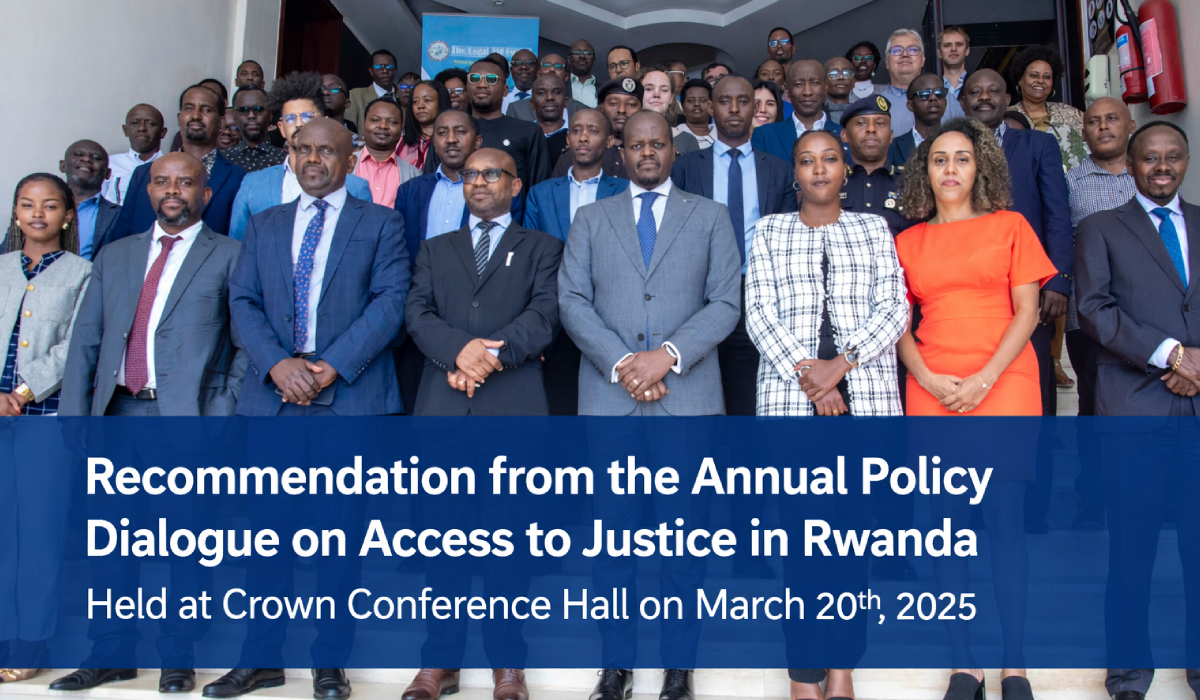
Rwanda has made efforts to improve access to justice through enactment of various policies such as the National Legal Aid Policy, the Alternative Dispute Resolution Policy, and the Criminal Justice Policy. On March 20th 2025, the Legal Aid Forum (LAF) convened key stakeholders from the justice sector to take stock and appreciate progress made and deliberate on challenges and develop actionable solutions to enhance access to justice for all, especially the vulnerable populations. The dialogue brought together representatives from government institutions, legal aid providers, civil society organizations, legal practitioners, and other relevant stakeholders.
The dialogue featured presentations and panel discussions focused on the impact of the 2014 National Legal Aid Policy in improving access to justice for vulnerable populations, the role of pro bono services, and civil society contribution to advancing access to justice. Participants engaged actively in discussions on these topics.
Stakeholders identified key barriers to effective access to justice and legal aid services in Rwanda as follows:
- Lack of Specific Legislation Governing Legal Aid
There is a notable gap in the legal framework, as no specific, comprehensive legislation explicitly governs legal aid services in Rwanda. While existing policies provide some guidance, the absence of clear, binding legal provisions leads to inconsistency in the provision of legal aid services across different regions and institutions. - Limited Legal Aid Coverage
A significant portion of the population, especially in rural and remote areas, continue to face limited access to legal aid. Legal aid services are predominantly concentrated in urban centers, leaving marginalized populations in distant locations without adequate support. This geographic disparity exacerbates inequality in access to justice. - Lack of Awareness of Legal Rights
Many individuals, particularly in marginalized communities, remain unaware of their legal rights or the availability of legal aid services. This lack of awareness prevents individuals from seeking legal assistance when needed. - Insufficient and unsustainable funding for legal aid
A key issue identified was the lack of sustainable funding for legal aid services. Limited government resources and heavy reliance on unpredictable donor funding by NGOs have led to service disruptions and reduced capacity to support vulnerable populations. This financial instability continues to hinder equitable access to justice in Rwanda. - Recognition and Integration of Paralegals
Paralegals play a critical role in bridging the gap in legal aid services, especially in underserved areas. However, their role is not officially recognized or integrated within the legal system. Legislative recognition of paralegals and the establishment of formal structures for their inclusion in the justice system are essential for enhancing access to justice. - Inadequate Coordination and Quality Control Mechanisms
There is a lack of coordination among various stakeholders involved in providing legal aid, including government institutions, legal aid organizations, and civil society organizations. This fragmentation can lead to inconsistent service delivery. Additionally, there is a need for robust quality control mechanisms to ensure that legal aid services meet established standards. - Long Travel Distance to Legal Aid Providers
Legal aid services are predominantly concentrated in urban areas, forcing individuals from rural or remote regions to travel long distances to access assistance. This imposes a considerable financial and logistical burden on individuals, particularly those from vulnerable or economically disadvantaged backgrounds. - Inadequate Implementation of Existing Policies
Despite the existence of progressive policies, such as the National Legal Aid Policy, significant challenges remain in effective implementation due to lack of proper communication between institutions and stakeholders, lack of resources and capacity. - Limited Capacity and Inadequate Training of Legal Aid Providers
Legal aid providers struggle with limited capacity and a lack of specialized training, which, combined with insufficient resources particularly in rural areas, significantly hinders their ability to deliver effective legal support to vulnerable groups such as GBV survivors and individuals with disabilities. - Inadequate Availability and Quality of Safe Spaces for Victims
While some safe spaces like Isange One Stop Centre exist for victims of gender-based violence (GBV) and other vulnerable individuals seeking legal aid, their availability remains limited relative to the growing demand. Additionally, many of the existing spaces do not fully meet the necessary standards to provide comprehensive protection, privacy, and support. Expanding and enhancing these facilities is essential to ensure that individuals can access legal assistance in a safe, stigma-free environment. - Barriers to Access for People with Disabilities
Individuals with disabilities, especially those in the deaf community, face unique barriers to accessing legal aid services. The lack of sign language interpreters especially in courts, limits their ability to access justice. - Limited Engagement of the Private Sector
Despite the growing demand for legal aid services, private sector involvement particularly through Corporate Social Responsibility (CSR) initiatives remain limited. Underutilization of CSR opportunities restricts the growth and long-term sustainability of legal aid organizations, which play a vital role in meeting the justice needs of vulnerable communities. - Community Resistance to Alternative Dispute Resolution (ADR)
Alternative Dispute Resolution (ADR) mechanisms, while effective in resolving disputes, face resistance in certain communities. This resistance is often due to a lack of understanding of ADR's benefits and its complementary role in formal legal processes. There is a need for increased education and awareness campaigns to enhance public understanding and acceptance of ADR methods.
II. Recommendations
After extensive discussions and debates, the following recommendations were formulated to address the key challenges in Rwanda's legal aid system, focusing on improving access to justice for vulnerable populations. These recommendations aim to enhance policy implementation, expand services, and strengthen the overall legal aid framework.
-
Legal Framework and Policy Reforms
- The Government of Rwanda should prioritize the enactment of comprehensive and specific legal aid legislation that clearly defines the rights and responsibilities related to the provision of legal aid services. This legislation should establish binding frameworks to ensure uniformity and consistency in legal aid services.
- The National Legal Aid Policy should be reviewed and strengthened to ensure its effective implementation and there should be harmonization of policies related to legal aid to eliminate contradictions and promote coherence in their application.
- The role of paralegals must be formally recognized and integrated within the legal framework. Legislative measures should define their roles and ensure that paralegals are appropriately trained, regulated, and incorporated into the legal aid system.
-
Expanding Access to Legal Aid Services
- The government, in collaboration with stakeholders, should ensure that legal aid services are available nationwide, especially in rural and remote areas. This can be achieved through the establishment of mobile legal aid units and regional offices, bringing services closer to marginalized communities and reducing travel burdens.
- A national strategy should be developed to digitize legal aid services, ensuring online accessibility for citizens, particularly in remote areas. Digital tools can also raise awareness of legal rights and available services, enhancing outreach to underserved populations.
-
Capacity Building, Resource Optimization, and Inclusive Legal Aid for Vulnerable Groups
- The government, in collaboration with legal aid providers and stakeholders, should actively engage the private sector to support and fund legal aid initiatives. Public-private partnerships must be encouraged to ensure the long-term sustainability and expanded reach of legal services, especially for marginalized populations. A strategic fundraising plan should be developed to involve financial institutions and other private sector actors in supporting legal aid programs.
- Legal aid services should be fully accessible to individuals with disabilities, with particular attention to the deaf community. This includes the provision of qualified sign language interpreters to guarantee effective participation in legal proceedings. Safe, confidential, and resource-equipped spaces must be established for survivors of gender-based violence (GBV) and other vulnerable individuals requiring legal assistance. These environments should offer comprehensive legal and psychological support.
- Scaling up capacity-building initiatives is crucial to ensure that legal professionals—lawyers, judges, prosecutors—are adequately equipped to address the specific needs of vulnerable groups. Specialized training should include trauma-informed approaches for GBV survivors and sign language proficiency for professionals serving people with hearing impairments.
- Legal aid providers should maximize available resources by focusing on high-impact areas such as GBV cases, juvenile justice, and services for persons with disabilities. This requires improved resource allocation, enhanced cross-sector collaboration, and the adoption of innovative, community-based service delivery models that can broaden the reach and impact of legal aid.
-
Establish a Sustainable and Diversified Funding Model for Legal Aid
- The government and NGOs should work towards creating a more sustainable and diversified funding model. The government should establish a dedicated national legal aid fund, supported by consistent contributions from public budgets and the private sector, to ensure the long-term provision of legal aid services particularly for vulnerable groups. At the same time, NGOs should reduce reliance on unpredictable donor funding by exploring alternative sources, such as partnerships with the private sector, and income-generating activities. This approach will help stabilize legal aid delivery and enhance access to justice for all.
-
Community Engagement and Legal Awareness
- Campaigns should be initiated to raise awareness about legal rights and the availability of legal aid services, targeting marginalized communities, including rural populations, people with disabilities, and victims of GBV.
- Public education initiatives should promote ADR mechanisms and their benefits through public forums, media campaigns, and community outreach to overcome resistance, especially in communities where traditional conflict resolution methods are predominant.
-
Strengthening Partnerships and Collaboration
- Government institutions should strengthen partnerships with civil society organizations (CSOs), particularly in policy reform, capacity building, and legal provision. Collaboration with CSOs will help extend the reach of legal aid services, increase public awareness and advocate for the rights of marginalized groups.
-
Monitoring, Evaluation, and Implementation
- A robust monitoring and evaluation (M&E) system should be implemented to assess the impact of legal aid programs. This system should collect data on service delivery, assess the effectiveness of interventions, and provide regular reports to inform future policy adjustments.
- The Ministry of Justice (MINIJUST) should take the lead in ensuring the effective implementation of legal aid policies, ensuring that progress is regularly monitored and adjusted as needed to achieve the desired outcomes.
Annex: List of Participants
| No. | Name | Gender | Institution |
|---|---|---|---|
| 1 | HABARUGIRA Angeline | F | DIDE |
| 2 | HABANABASHAKA Emmanuel | M | NCHR |
| 3 | BARAHIRA MUKAZANA Fidela | F | ARDHO |
| 4 | Moise NKUNDABARASHI | M | RBA |
| 5 | MUSEVENI Emmanuel | M | RIB |
| 6 | MUKAMISHA Claudine | F | Office of the Ombudsman |
| 7 | Mary-Aline Balikungeri Vuningoma | F | Rwanda Women's Network |
| 8 | IRAKOZE Ornella Chelssy | F | Rwanda Bridges to Justice Network |
| 9 | MUNEZERO Esther Bella | F | Certa Foundation |
| 10 | BANGAYANDUSHA Viateur | M | ILPD |
| 11 | Florence MUKAMUGENI | F | UR |
| 12 | MUNYANGONDO Emmanuel | M | UNDP |
| 13 | Jonas MUNYAGASIZA | M | ARDHO |
| 14 | Ndiyaye U. Innocent | M | ULK |
| 15 | HIRWA Yannick Boris | M | GMO |
| 16 | Janviere MUKANTWARI | F | UN Women |
| 17 | IZERE Emmanuel | M | NUDOR |
| 18 | IRAKOZE Kevine | F | NUDOR |
| 19 | MUGABO Frank | M | MINIJUST |
| 20 | MUTAGANIRA Emelyne | F | LOH |
| 21 | RITA Moreira | F | Embassy of Denmark |
| 22 | NSHIMIYIRWA M. Xavier | M | ARDHO |
| 23 | ALICE UMULISA K. | F | LAF |
| 24 | Ruboya Antoine | M | MINIJUST |
| 25 | Manirabaga Emmanuel | M | ADR Centre |
| 26 | Sotirios BAZIKAMWE | M | EU |
| 27 | INGABIRE Alexis | M | COPORWA |
| 28 | MUKASHEMA M. Louise | F | RBA |
| 29 | Mbonera Theophile | M | MINIJUST |
| 30 | Anathase Havugimana | M | EKN |
| 31 | Bushayija Paul | M | Rwanda Women's Network |
| 32 | Bananeza Douce Sabrine | F | CESTRAR |
| 33 | MUGABO Fidele | M | LAF |
| 34 | Lorenzo Wakefield | M | Mott Foundation |
| 35 | Jonathan Musangwa | M | HRFRA |
| 36 | Hans Bretschneider | M | GIZ |
| 37 | Ndayisaba Aphrodis | M | AJPRODHO |
| 38 | Bernard Jolly | M | JAP |
| 39 | Sanne Schelringa | F | Dutch Embassy |
| 40 | Karolina Uwantege K. | F | RFI |
| 41 | Mukarukundo Odette | F | TI-Rwanda |
| 42 | Harrison Mutabazi | M | Judiciary |
| 43 | Ngoran Evaristus | M | OHCHR |
| 44 | Aimable Nshizirungu | M | RCS |
| 45 | Cyiza Yvonne | F | Haguruka |
| 46 | Zikamabahari Jean de Dieu | M | UoK |
| 47 | Eric Kanyabuganza | M | RNP |
| 48 | Tite Niyibizi | M | NPPA |
| 49 | Jean Maurice Ukobizaba | M | RLRC |
| 50 | Liliane Iradukunda | F | KIAC |
| 51 | Schmid Lyna Alami | F | Haguruka |
| 52 | Pitie Benedict Rasana | M | GLIHD |
| 53 | Eichel Illum Johan | M | Denmark |
| 54 | Mudaheranwa Desire | M | Kanyarwanda |
| 55 | Ingabire Gina | F | Isango Star |
| 56 | Solange Tuyishime | F | Isango Star |
| 57 | John Mugisha R | M | Rwanda Dispatch |
| 58 | Ntabareshya Jean de Dieu | M | IGIHE |
| 59 | Juventine Muragijemariya | F | RBA |
| 60 | William Evans Mutabazi | M | RBA |
| 61 | Nkuranga Patrick | M | RBA |
| 62 | Kwizera Samwel | M | Flash TV |
| 63 | Hakizimana Marachie | M | Kigali Today |
| 64 | Andrews KANANGA | M | LAF |
| 65 | Sandra KABASINGA | F | LAF |
| 66 | Leonie MUTONI | F | LAF |
| 67 | Alexis HABIMANA | M | LAF |
| 68 | Cecilia RUTEMBESA | F | LAF |
| 69 | Brenda BATAMURIZA | F | LAF |
| 70 | Crispin RWIRANGIRA | M | LAF |
| 71 | Patrice MUNYANTARAMA | M | LAF |
| 72 | Vanessa BUGINGO | F | LAF |


.jpg)