
I. Background
Rwanda has made commendable strides in strengthening access to justice through deliberate legal, institutional, and policy reforms. The Government has also promoted alternative dispute resolution mechanisms, digitalized justice services, and invested in community legal awareness initiatives to ensure that vulnerable populations can effectively access justice. These reforms have brought justice services closer to citizens and strengthened the overall responsiveness of Rwanda's justice system.
Over the past 20 years, the Legal Aid Forum (LAF), has played a critical role in advancing these reforms by providing technical inputs during consultations of amendments of laws as well as through evidence-based advocacy. LAF further contributes to efforts in advancing access to justice by providing legal aid services, including legal representation, legal awareness, mediation, and legal advice to the most vulnerable groups of people in communities. These efforts have helped mitigate financial and informational barriers that often prevent justice seekers from navigating the justice system.
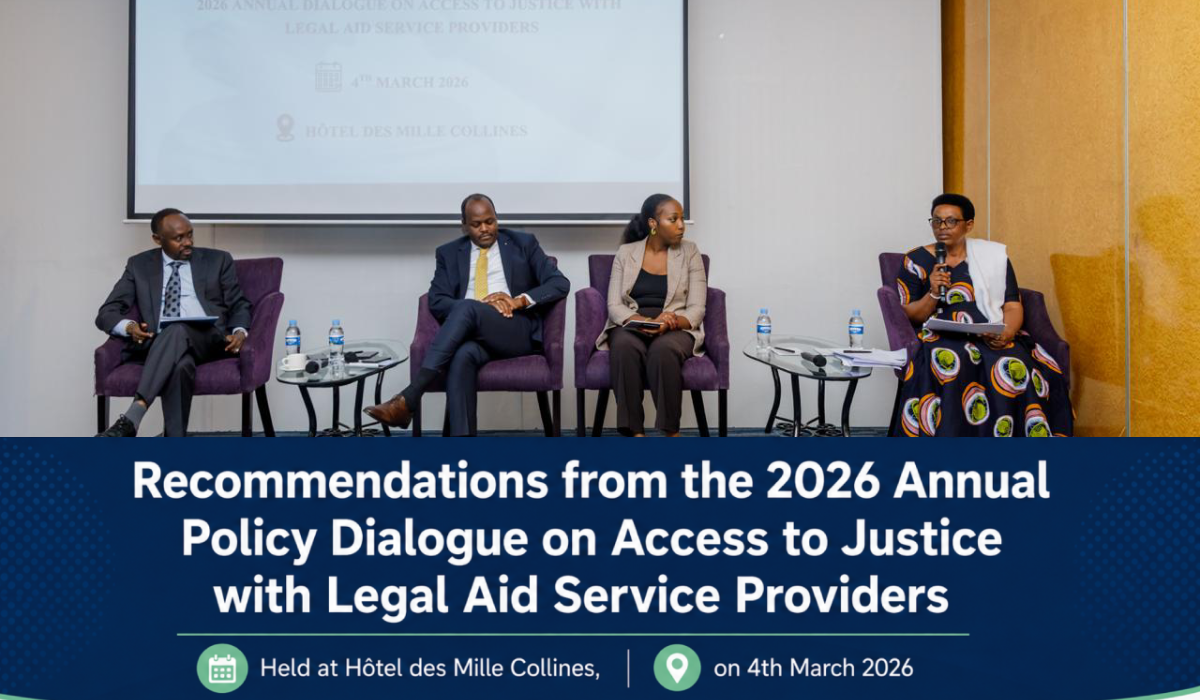
On 4th March 2026, LAF convened its Annual Dialogue on Access to Justice with Legal Aid Service Providers as a follow-up to the 2025 Annual Policy Dialogue, to discuss issues around access to justice and legal aid for vulnerable groups in Rwanda. The dialogue featured a presentation on the contribution of non-state legal aid service providers in promoting access to justice, using LAF as a case study, followed by a panel discussion on approaches to legal aid service delivery by civil society actors.
The dialogue focused on reviewing the current legal aid landscape, identifying persistent challenges faced by vulnerable populations, sharing innovative approaches to service delivery, and fostering collaboration between state and non-state actors. Discussions highlighted that while progress has been made, there remains a need for structured reflection and stronger coordination among legal aid providers to enhance collective impact.
Insights from these discussions informed the identification of key challenges facing the sector and guided the formulation of targeted recommendations to strengthen access to justice for vulnerable populations in Rwanda.
II. Key Challenges Identified
Stakeholders identified key challenges currently facing the legal aid system in Rwanda, including but not limited to:
-
Absence of a dedicated legal aid law
Rwanda does not have legislation explicitly governing legal aid services in the country. Even though there is 2014 National Legal Aid Policy and the 2022 Alternative Dispute Resolution and Criminal Justice Policies which provide some guidance, the lack of dedicated law on legal aid is necessary to address inconsistencies in the provision of legal aid services, improve coordination among legal aid providers and establish sustainable funding mechanism for legal aid in Rwanda. -
Urban-rural justice service delivery gap
Legal aid service providers remain heavily concentrated in urban centres, creating a significant access gap for rural populations. Geographic distance and financial barriers further compound this disparity, forcing many individuals to forgo legal remedies altogether. As a result, vulnerable groups in rural areas particularly women, low-income households, and persons with disabilities face disproportionate barriers to justice. -
Weak stakeholder coordination
Although more than 25 organizations operate within the legal aid ecosystem, coordination remains fragmented. There is no consistently functioning mechanism to align priorities, share data, or avoid duplication of services. The underutilization of the MIS Ganubutabera platform evidenced by lack of active users among the 58 trained actors highlights both technical and institutional challenges, including limited ownership, inadequate follow-up, and possible usability concerns. This fragmentation reduces overall efficiency, weakens collective advocacy efforts, and limits the sector's ability to generate reliable, consolidated data for planning and policy-making. -
Unsustainable funding for legal aid
The legal aid sector continues to rely heavily on donor funding, which is often short-term, project-based, and unpredictable. This creates uncertainty for service providers, constrains long-term planning, and disrupts continuity of services for beneficiaries. The absence of a national pooled fund or a structured domestic financing mechanism further exacerbates this vulnerability, leaving the sector without a stable financial foundation. As a consequence, critical services risk interruption when funding cycles end. -
Unrecognized paralegals
Community paralegals play a vital frontline role by providing legal information, mediation support, and referrals, particularly in underserved areas. However, their contributions remain largely informal due to the lack of legal recognition, standardized accreditation, and clear regulatory frameworks. This limits their effectiveness, restricts their ability to formally engage with justice institutions, and raises concerns about quality assurance and accountability. Without integration into the formal justice system, the potential of paralegals to expand access to justice in a cost-effective and scalable way remains underutilized. -
Inadequate GBV coordination
While over 44 Isange One-Stop Centres have been established to provide integrated services for survivors of gender-based violence (GBV), coordination at the national level could be further strengthened. The lack of a unified GBV coordination framework and a clearly mandated lead agency can contribute to fragmented service delivery, inconsistent referral pathways, and gaps in data sharing. As a result, survivors may face delays, duplication, or disruptions in accessing medical, legal, and psychosocial support. Enhancing coordination mechanisms would help ensure a more survivor-centred, efficient, and accountable response system.
III. Recommendations
After extensive deliberations, the following targeted recommendations were proposed to address key challenges within Rwanda's legal aid sector, with particular emphasis on strengthening legal and policy frameworks, enhancing stakeholder coordination, securing sustainable funding, and improving service delivery, especially for vulnerable populations.
-
Adopt a dedicated legal aid law
The Government of Rwanda should prioritize the enactment of a dedicated Legal Aid Law. This legislation should establish frameworks to ensure uniformity, consistency, and enforceability in the delivery of legal aid services across all providers. The law should also provide a clear institutional framework for coordination, regulation, and oversight of legal aid services, ensuring accountability of both state and non-state actors and strengthening access to justice for vulnerable populations. -
Legal recognition of community paralegals
Community-based paralegals should be formally recognized within the justice system through a regulatory framework that defines their roles, responsibilities, and standards of practice. This framework should include accreditation standards, a code of conduct, and structured linkage to oversight mechanisms such as the Rwanda Bar Association, in order to ensure professionalism, quality assurance, and effective integration into the formal legal aid system. -
Expand rural access through paralegals
The government, in collaboration with stakeholders, should develop and fund a structured paralegal programme to extend legal aid coverage to the sector level across all 30 districts, with priority given to the districts with the lowest legal aid coverage. This intervention should strengthen community-based justice delivery mechanisms by equipping paralegals to provide basic legal assistance, awareness, and referrals, thereby reducing geographical and financial barriers to access to justice, particularly in rural and underserved areas. -
Revitalize stakeholder coordination
The MIS Ganubutabera platform should be revitalized through mandatory usage by all legal aid providers to ensure effective data collection, reporting, and information sharing across the sector. Quarterly coordination meetings should be institutionalized and co-chaired by MINIJUST and LAF in order to strengthen coordination among legal aid actors, reduce duplication of efforts, and enhance alignment in planning, implementation, and monitoring of legal aid interventions. -
Establish a national legal aid fund
The Government should establish a National Legal Aid Fund supported by domestic financing contributions to ensure predictable and sustainable funding for legal aid services. This should be complemented by a multi-donor basket funding mechanism to reduce reliance on fragmented and single-source donor funding, while strengthening coordination, transparency, and efficiency in resource allocation within the sector. -
Develop a national GBV coordination framework
A national GBV legal aid coordination framework should be developed to integrate all 44+ Isange One-Stop Centres into a unified referral, reporting, and case management system, ensuring a coordinated, timely, and survivor-centred response to gender-based violence cases.
Annex: List of Participants
| No. | Name | Gender | Institution |
|---|---|---|---|
| 1 | Lorenzo Wakefield | M | Mott Foundation |
| 2 | Me Andrews Kananga | M | LAF |
| 3 | Mukamurara Florence | F | CBA |
| 4 | Me. Mugabo Fidèle | M | Advocate -LAF |
| 5 | Ms. Kwineza Odette | F | UR-CLAM |
| 6 | Me. Umwali Sylvie | F | Advocate/LAF |
| 7 | Me. Ibambe Jean Paul | M | RBA |
| 8 | Impundu Orchidée | F | RWN |
| 9 | Musangwa Jonathan | M | HRFRA |
| 10 | Me. Uwase Sabine | F | RBA |
| 11 | Dr. Zikamabahari John | M | University of Kigali |
| 12 | Mbonera Theophile | M | MINIJUST |
| 13 | Me Mukashema Marie Louise | F | RBA |
| 14 | Jolly Bernard | M | EU JAP |
| 15 | Elwin Rwamurangwa | M | RBJ |
| 16 | Me. Banguwi Ha Vianney | M | RBA |
| 17 | Me. Kalimba Daniel | M | Advocate LAF |
| 18 | Mukayisenge Caroline | F | MINIJUST |
| 19 | Mary-Aline Balikungeri | F | RWN |
| 20 | Twiringiyimana Theogene | M | LAF |
| 21 | Mutamba Ruth | F | LAF |
| 22 | Rutembesa Cecilia | F | LAF |
| 23 | Leonie Mutoni | F | LAF |
| 24 | Cyiza Yvonne | F | HAGURUKA |
| 25 | Twahirwa André | M | MINIJUST |
| 26 | Akimana Laurence | F | MINIJUST / MAJ |
| 27 | Mugabo Frank | M | MINIJUST |
| 28 | Moise Nkundabarashi | M | RBA |
| 29 | Mutabazi Harrisson | M | Judiciary |
| 30 | BATAMURIZA Brenda | F | LAF |
| 31 | Joakim Kirkegaard Genz | M | Danish Embassy |
| 32 | Me. Rwagasana Innocent | M | ADL |
| 33 | Me. Uwimabera Béate | F | ADL |
| 34 | Musurizi George | M | NCHR |
| 35 | Umunyana Charity | F | Ombudsman Office |
| 36 | Dukundane Jean Luc | M | MINIJUST / MAJ |
| 37 | Rwabigwi Augustin | M | Rwanda Bar Association |
| 38 | Sotirios Bazikamwe | M | EU |
| 39 | Nukarukundo Odette | F | TI-Rwanda |
| 40 | Nshutiraguma Espérance | F | ARDHO |
| 41 | Me. Manishimwe Juvenal | M | SLL |
| 42 | Dr. Bangayandusha Viateur | M | ILPD |
| 43 | Twagirimana Eugene | M | NUDOR |
| 44 | Kamanzi Arielle | F | LAF |
| 45 | Vanessa BUGINGO | F | LAF |
| 46 | Uwera Tania Pintia | F | AJPRODHO |
| 47 | Natalie Cass | F | Embassy of Denmark |
| 48 | Me Alice Umulisa Kayigamba | F | Advocate_LAF |
| 49 | Maniranbona Olivier | M | Isango Star |
| 50 | Yassin Tuyishimire | M | Isango Star |
| 51 | Leonidas | M | IGIHE-Com |
| 52 | Kwizera Herve | M | IGIHE-Com |
| 53 | Grace Twahirwa | F | LAF |